Showing posts with label Learn Korean. Show all posts

2013/09/06

the folk anthem of korea '아리랑(Arirang)'


Today I'd like to introduce to you 'Arirang'
 the Intangible Cultural Heritage of Humanity designated as UNESCO
and the best beloved korean fork song as well.


 Arirang is a popular form of korean folk song and the outcome of collective
contributions made by ordinary koreans throughout generations.
 Essentially a simple song, it consists of the refrain 'Arirang,arirang,arariyo'
 and two simple lines, which differ form region to region.
While dealing with diverse universal themes,the simple musical and literary
 composition invites improvisation,imitation and singing in unison,
 encouraging its acceptance by different musical genres.

Now we'll listen the original song!!


Jazz version 'Arirang'
Arirang in jazz version is so nice that I really like to recommend you to listen.


(Text adapted from www.arirangschool.or.kr)

 Experts estimate the total number of folk songs carring
the title 'Arirang' at some 3,600 variations belonging to about sixty versions.
A great virtue of Arirang is its respect for human creativity,
freedom of expression and empathy.
Everyone can create new lyrics, adding to the song's regional,
historical and genre variations,and cultural diversity.
Arirang is universally sung and enjoyed by the Korean nation.
 At the same time, an array of practitioners of regional versions,including local communities, private groups and individuals,  actively lead efforts for its popularization and transmission, highlightingthe general and local characteristics of individual versions.
 
Arirang is also a popular subject and motif in diverse arts and media,
 including cinema,musicals, drama, dance and literature.
  It is an evocative hymn with the power to enhance communication and unity
among the korean people, Whether at home or abroad.

2013/08/20

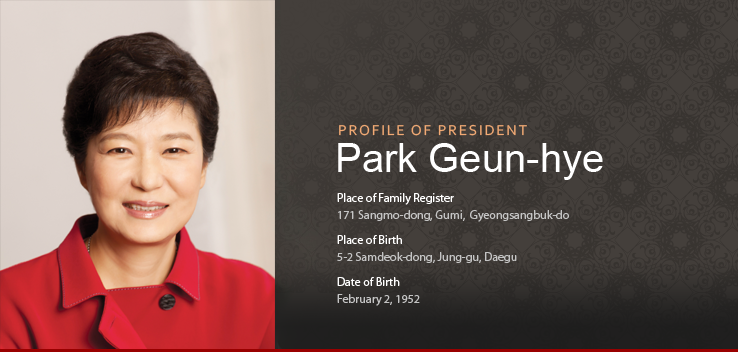
PARK GEUN-HYE INARGURATED AS FIRST FEMALE PRESIDENT OF SOUTH KOREA

(Photo by Chung Sung-Jun/Getty Images)
 
Park Geun-hye ( born 2 February 1952)
is the eleventh and current President of South Korea.
She is the first woman to be elected as President in South Korea,
 and is serving the 18th presidential term.
She also is the first woman head of state in modern history of Northeast Asia
 

(The source of wikipedia)

 Prior to her presidency, she was the chairwoman of the conservative Grand
 National Party (GNP) between 2004 and 2006 and between 2011 and 2012
 (the GNP changed its name to "Saenuri Party" in February 2012).
 
Park was also a member of the Korean National Assembly, and had served
 four consecutive parliamentary terms as a constituency
 representativebetween 1998 and 2012; starting
her fifth term as a proportional representative from June 2012.
 
 Her father was Park Chung-hee, President of South Korea from 1963 to 1979.
She is generally considered to be one of the most influential politicians in Korea since the presidencies of the two Kims: Kim Young-sam and Kim Dae-jung


Her Story

As a politician, President Park Geun-hye has
always cherished trus and keeping her promises.
These values have been most important to her in her life and in her career.

She was born during the Korean War in 1952.
Her father was Park Chung-hee, who in 1963 became
President of the countryand led the Miracle on the Han River.
Her mother, Yuk Young-soo, was beloved and respected when she became First Lady. From the example of her father, President Park Geun-hye learned love of countryand mental fortitude.From her mother, she learned warm regard for others
 and a lifestyle of diligence and frugality.

(The source of wikipedia & president.go.kr)
 

In 1974, she graduated at the top of her class with a major in
electronic engineering from Sogang University, Seoul.
Then in August, she left Korea to study at the University of Grenoble,
 France, in preparation for her dream job: teaching.
A month had not even passed when she received an urgent message to return to Korea
 at once. When she arrived at the airport, the headline of one of the papers caught her eye. She froze on the spot. Above the photo of her mother, it read, “Assassinated.
” This was how she first learned of her mother’s tragic death.
 
Only a week later, she took up the role of acting First Lady; she was only 22 years old.
 As the First Lady for five years, she accompanied her father on
his visits to numerous sites in the countryside, as well as on his frequent
 official tours overseas. She also received foreign envoys.

 
After President Park Chung-hee was assassinated,
she spent the next 18 years in quiet contemplation and in serving the disadvantaged.
What triggered her entry into politics was a feeling of desperation over the
 foreign currency crisis that engulfed the country in 1997.
 
She thought, “Korea was built with so many sacrifices by everyone
 and cannot go under like this.” In April 1998, she ran on the Grand National Party ticket in a by-election in Daegu and became a member of the National Assembly.
From then on, she won a total of five consecutive general elections in the district.
 
 
In 2002 and again in 2011, she took over the helm of the Grand National Party at times when it was in crisis and in danger of being sidelined and made it the majority party.
 
In 2011, the party name was changed to Saenuri (New Frontier).
These efforts based on her determination to win the trust of the public by making
 her actions match her words, keeping her promises and focusing the
 party's efforts on policies were considered political miracles.
 They also made her a strong candidate for president.
 
 
On December 19, 2012,
she was elected President of the country—the first female President in Northeast Asia.
 She was inaugurated on February 25, 2013.


2012/09/17

The national flower of Korea "Mugunghwa"


"Mugunghwa" The Rose of Sharon


According to ancient scriptures, Koreans have treasured the rose of Sharon,
 or "Mugunghwa", as a heavenly flower since the ancient times.
 As such it was a great choice for Korea's national flower.


The Shilla Kingdom called itself the Mugunghwa Country, and even the ancient Chinese referred to Korea as "The land of gentlemen where Mugunghwa blooms.
" Love for the flower was further heightened whenMugunghwa samcheolli hwaryeo gangsan" ("Rose of Sharon, thousand miles of beautiful mountain and river land!")
 was written into the national anthem of the late 19th century.
As the rose of Sharon has been an important part of the Korean culture for centuries,
 it was only natural that the government adopted it as the national flower
 after Korea was liberated from Japanese colonial rule.
 

There are more than 100 types of the rose of Sharon indigenous to Korea.
 There are single, semi-double, and double types of flowers.
 Depending on the colors of the flower, they are divided into 3 groups,
 Dansim (a flower with a red center), Baedal (a Pure white flower),
 and Asadal (a flower with pink dots on the edges of its petals).
 The Dansim and single type of flowers, serve as Korea's national flower.


The rose of Sharon blooms from early July through late October.
 Around 2,000 to 3,000 bloom on a single plant, which is strong enough to survive even when it is transplanted or cut for decoration or flower arrangements.
Thus, the everlasting flower represents the wish for
lasting national development and prosperity.

Koreans cherish and care for the national flower as it symbolizes the many triumphs and successes the country has experienced and the trials and tribulations the people have overcome. The Mugunghwa is not simply a flower: it's Korea's victory in history.


photo by http://cafe.naver.com/dsmjlee


2012/01/18

Hanbok, Korean Traditional Costume


Hanbok, Korean Traditional Costume

Hanbok, Korean traditional costume, reflects theculture of Korea.
The woman's hanbok consists of juogori, a blouse, and a skirt called chima.


The man's hanbok consists of a longer jeogori and baggy pants called baji.
 Like much of Korean art, the hanbok is characterized by curves,
 flowing lines, and plenty of blank spaces.


There is a reason why the hanbok covers almost the whole body.
Confucianism has ruled the Korean minds
 for much of the country's history.


The hanbok reflects these traditional values,
 and the various types of haboks reflect the social staus of the wearers.


The long white overcoat has long symbolized
the dignity of the traditional gentleman.


Noble women of the Joseon period wore long coats called jangot.
 Whenever they went out, it was considered
polite for a woman not to show her face in public.


Colors also showed social status and personal background.
Common people were dressed in white except for seasonal festivals or special events,

when they were dressed in the hanbok made of bright primary colors.
The ruling class, on the other hand, often wore primary colors.


  Unmarried women trsditionally wore yellow jeogori and red chima,
an attractive combination.
 After marriage, the color of a woman's ceremonial
costume showed her husband's social status.


Interestingly the Korean traditional costume reflects
perhaps a belief that the clothes do, in fact, make the man or woman.


2011/09/05

Korean Currency (Won)


All countries have their own currency.
 For example, Americans Dollar and Japanese Yen. Specially, Europeans that live in Europe continent (except some countries) using "Euro".
 Korea has its own currency too.

Today I’ll introduce
"Korean money" to you!!

Korean currency can be divided into paper money and coin.
 At first, I’ll introduce paper money. At present,
there are 4 kinds of paper money in Korea.
 That are 50.000won,10,000 won, 5,000 won, 1,000 won.

Won is Korean monetary unit.

(Image-http://blog.naver.com/firstmydream)

Five thousand-won note's color is yellow color.
You can see korean artist,calligraphy,noted poet,
and the mother of the korean confucain scholar Yulgok.
often held up as a model of confucian ideals,her respectful
nick name was Eojin Eomeoni(wise mother)

Ten thousand-won note's color is green color.
You can see Korean King "Sejong the Great" at front,
" Gyeonghoeru" pavilion at the back.

Five thousand-won note's color is red-brown color.
 You can see Lee lee, a famous scholar, and his hometown, Ojukheon.

A thousand-won note's color is bright-pink color.
 On this note, you can see another famous scholar.
His name is Lee Hwang.
Back of a thousand-won, you can see the lecture hall, Dosan lecture hall.
 It was established by Lee Hwang.

(Image-http://blog.naver.com/firstmydream)

1 USD= 1,080 (WON)
1 RM= 370 (WON)
(2011.09.05)

(It's easier if you just look at the won and take
 off 3 zeros to convert it to dollars)

 Coins are 500 won, 100 won, 50 won, 10 won.
 
Now, Koreans are passing four kinds of coins.
500 won has biggest size among them. And 10 won is the smallest of them.
Only 10 won's color is gold. Other color is silver.

Those are Korean money. Koreans always carry them.
 If you have much money, 
you can buy products anywhere in Korea.


2011/08/29

Korean Martial Arts-Taekwondo


Taekwondo translates as “the art of  kicking and punching,”
and as advertised, utilizes kicks, punches and blocks as a means of combat.
Some believe it to be the most popular martial arts in the world, practiced by some 70 million people of all ages and sexes in about 200 countries around the world.
 The extent of its popularity was proven in 2000,
when it was adopted as an event in the Summer Olympic Games.


Taekwondo began to take off as a
 national sport in the 1950s, during and right after the Korean War.
Military men and martial artists such as Choi Hong-hi and Nam Tae-hi played
a major role in promoting the tradition,
impressing Korean President Rhee Syngman so much that he asked them to teach the art to the Korean Army, where it is still taught to soldiers


Taewondo distinguishes itself from other martial arts such as karate
or kung fu with its emphasis on kicks, particularly from a moving position. Students usually learn a number of other things,
 including patterns, breaking objects like boards and ice and spiritual training. Practitioners usually wear a white uniform with a belt:
 the color of which determines the rank of the practitioner.
The darker the color, the higher the rank, with black being the highest.

v


The two biggest Taekwondo organizations in the world are
the International Taekwon-Do Federation and World Taekwondo Federation, the latter of which is a member of the International Olympic Committee (IOC).

More Info
International Taekwon-Do Federation (www.tkd-itf.org)
World Taekwondo Federation (www.wtf.org
(source-visit korea)


((Taekwondo as a fitness program is very effective in helping children to grow.
young adults and middle-aged or old people to enhance their physical strength,and females(women)to take care of their health and beauty))


2011/07/27

South korean Flag


South Korean Flag Description

The flag, called "Tae Kuk "
symbolizes the thought, philosophy,and mysticism of the Far East.
 The circle in the center,
 red upper half and blue lower half, represents absolute,
 or the essential unity of all being.
The Yang (positive) and the Yin (negative) divisions
within the circle represent duality.
Examples of duality are heaven and hell, fire and water,
life and death, good and evil, or night and day

The four trigrams also indicate the duality of opposites and balances.

 In the upper left trigram, three unbroken lines symbolize Heaven;
 opposite them in the lower right,
three broken lines represent Earth.
 
In the upper right trigram, two broken lines separated
 by an unbroken line is the symbol of Water;
opposite them is Fire, symbolized by two unbroken
 linesseparated by a broken line.
Symbolic of the nation is the white background (the land),
the circle (people), and the four trigrams (the government).
All three make up the essential elements of the nation.


"Aegukga" South Korea National Anthem English lyrics

.

Aegukga

1.Until the East Sea's waves are dry,
 (and) Mount Paektusan worn away God watch o'er our land forever!
Our Korea manse
!

2. Like Mount Namsan armored pine, standing on duty still,
wind or frost, unchanging ever, be our resolute will.


3. In autumn's arching evening sky, crystal,
and cloudless blue,Be the radiant moon
our spirit,steadfast, single and true.

4. With such a will, (and) such a spirit, loyalty, heart
 and hand,Let us love, come grief,
come gladness, this our beloved land!

*Refrain*
Rose of Sharon, thousand miles of range and river land!
Guarded by her people, ever may Korea stand!